


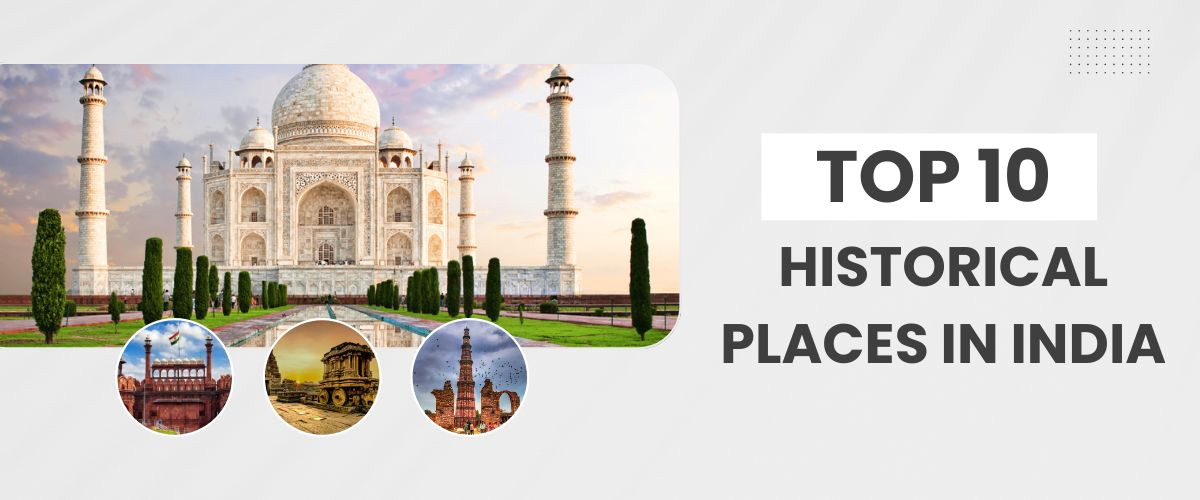
The top 10 historical places in India span more than two thousand years of history, from ancient rock-cut caves to Mughal marble and Rajput hill forts. This guide gives you the whole list in one scannable chart, then a short profile of each site, the best time to visit, and the easiest way to see them on a single trip. Most sit along well-worn routes, so with a little planning you can tick off several in one journey.
We have driven visitors to these monuments since 2013, so the practical notes below come from real trips, not a guidebook.
Table of Contents
Top 10 historical places in India at a glance
| Monument | Location | Built | Known for | Nearest airport |
|---|---|---|---|---|
| Taj Mahal | Agra, Uttar Pradesh | 1631 to 1653 | Marble Mughal mausoleum | Agra or Delhi |
| Red Fort | Delhi | 1638 to 1648 | Mughal imperial fort | Delhi |
| Qutub Minar | Delhi | 1199 to 1220 | Tallest brick minaret | Delhi |
| Amber Fort | Jaipur, Rajasthan | 1592 | Hilltop Rajput fort | Jaipur |
| Fatehpur Sikri | Agra, Uttar Pradesh | 1571 to 1585 | Abandoned Mughal capital | Agra or Delhi |
| Mehrangarh Fort | Jodhpur, Rajasthan | 1459 | Cliff-top fort over the blue city | Jodhpur |
| Hampi | Karnataka | 14th century | Vijayanagara ruins | Hubli or Bangalore |
| Ajanta and Ellora Caves | Maharashtra | 2nd century BCE onward | Rock-cut cave temples | Aurangabad |
| Khajuraho Temples | Madhya Pradesh | 950 to 1050 | Finely sculpted temples | Khajuraho |
| Konark Sun Temple | Odisha | around 1250 | Chariot-shaped sun temple | Bhubaneswar |
Most of these are UNESCO World Heritage sites, which is a useful shortlist if you want to focus on the very best.
The 10 historical places in detail
1. Taj Mahal, Agra
The most famous monument in the country, built by Shah Jahan as a mausoleum for his wife. Go at sunrise for soft light and smaller crowds. It is closed on Fridays.
2. Red Fort, Delhi
The red sandstone fort that served as the seat of Mughal power for two centuries. Its scale and the halls of public and private audience are the highlights, and it anchors any tour of Old Delhi.
3. Qutub Minar, Delhi
A 73-metre victory tower begun in 1199 and the tallest brick minaret in the world. The surrounding complex includes an iron pillar that has resisted rust for over 1,600 years.
4. Amber Fort, Jaipur
A hilltop fort of honey-coloured stone above Maota Lake, built by the Rajputs and full of mirrored halls and painted gateways. It is the standout sight of Jaipur.
5. Fatehpur Sikri, near Agra
A complete Mughal capital built by Akbar and then abandoned within a couple of decades, so it survives almost intact. An easy stop between Agra and Jaipur.
6. Mehrangarh Fort, Jodhpur
One of the largest forts in India, rising straight out of a cliff above the blue houses of Jodhpur. The views over the old city are the reason to climb up, and the museum inside is excellent.
7. Hampi, Karnataka
The vast ruins of the Vijayanagara empire, scattered across a boulder-strewn landscape in the south. Temples, palaces and market streets stretch for kilometres, and it rewards a couple of unhurried days.
8. Ajanta and Ellora Caves, Maharashtra
Two sets of rock-cut cave temples carved into cliffs, one Buddhist and older, the other a mix of Buddhist, Hindu and Jain. The Kailasa temple at Ellora, cut from a single rock, is the single most astonishing thing on this list.
9. Khajuraho Temples, Madhya Pradesh
A group of temples built by the Chandela dynasty, known for their detailed stone carving. Remote but well worth the trip for anyone interested in temple art.
10. Konark Sun Temple, Odisha
A 13th-century temple designed as the sun god’s chariot, complete with giant stone wheels. It sits near the coast in the east and pairs well with a wider Odisha trip.
Best time to visit India’s historical sites
The cool, dry season from October to March is the most comfortable time to explore monuments across most of the country. The northern sites around Delhi, Agra and Rajasthan get very hot from April to June, so start early in the day if you travel then. The monsoon from July to September brings rain but also green landscapes and thinner crowds. Our best time to visit India guide covers the seasons in detail.
How to visit these historical places
The good news is that many of these cluster together. The Taj Mahal, Red Fort, Qutub Minar, Fatehpur Sikri and Amber Fort all sit on the Golden Triangle route between Delhi, Agra and Jaipur, and Mehrangarh is a natural add-on through Rajasthan. The southern and eastern sites take a domestic flight and a few extra days.
The simplest way to see several without the logistics is a private car with a driver. You are collected from your hotel, driven to each monument, and moved between cities in comfort, with someone who knows the routes, the timings and the best hours to beat the crowds. We plan these trips end to end, so all you do is enjoy the sights. See our Golden Triangle tour packages, our Rajasthan tours, and how our chauffeur-driven service works. The Golden Triangle itinerary shows how the northern sites fit together.
The bottom line
The top 10 historical places in India cover the full sweep of the country’s past, and the northern half of the list can be seen comfortably in a single week. Pick the sites that interest you most, travel in the cool season, and let a driver handle the roads so you can spend your energy on the monuments rather than the map.
Frequently Asked Questions
Which is the oldest historical place in India on this list?
The Ajanta Caves are the oldest, with the earliest work dating to around the 2nd century BCE, followed by the Khajuraho and Konark temples from the medieval period.
How many days do I need to see India’s top historical places?
The northern sites on the Golden Triangle and into Rajasthan can be seen in about 6 to 9 days. Adding the southern and eastern sites needs another few days and a domestic flight.
What is the best time to visit historical monuments in India?
October to March is the most comfortable season. In the hot months from April to June, visit early in the morning before the heat builds.
Are these historical places UNESCO World Heritage sites?
Most of them are, including the Taj Mahal, Red Fort, Qutub Minar, Fatehpur Sikri, Hampi, Ajanta and Ellora, Khajuraho and Konark.
What is the easiest way to visit these monuments?
A private car with a driver is the most comfortable option, especially on the Golden Triangle and Rajasthan routes, since it handles all the transfers and timings for you.
Want to see India’s greatest monuments without the logistics? Travel with your own car and driver, at your own pace, with every transfer and timing handled. Tell us your dates and we will send a tailor-made quote within 24 hours. Get your free quote.


Leave a Reply