


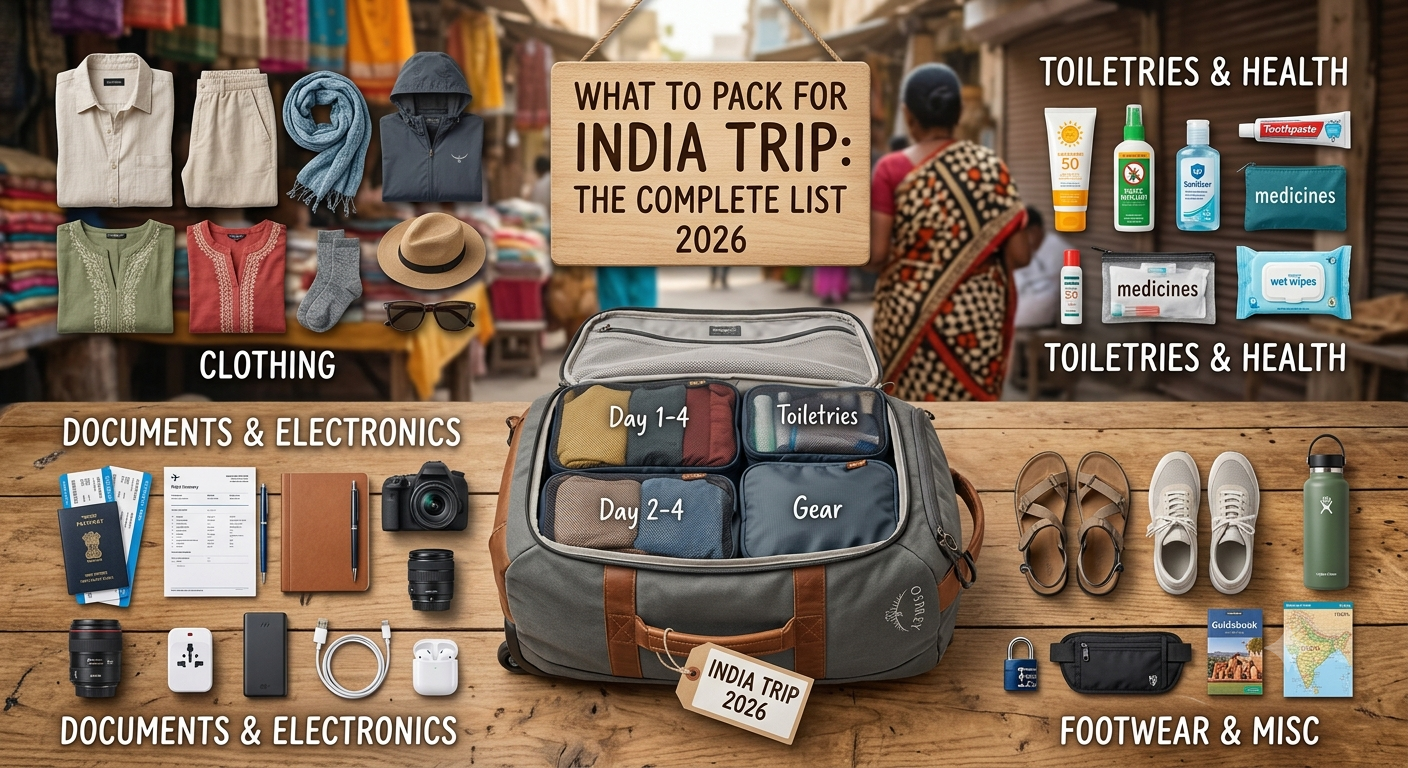
Most of the tourist ask us what to pack for India trip after years of driving travellers from all over the world across India, our team has seen exactly what people over-pack, what they forget, and what actually makes a trip easier. This is the packing list we wish every guest had before they flew. It covers what to wear, what to bring by season and by region, and the practical things that are easy to miss. There is a quick checklist first, then the detail.
📥 Download the free India Packing Checklist (PDF)
Table of Contents
Quick India packing checklist
If you read nothing else, bring these:
- Lightweight, loose clothes that cover your shoulders and knees
- One scarf or shawl (for temples, sun and cool evenings)
- Comfortable, closed walking shoes plus easy slip-on sandals
- A small first-aid and stomach-upset kit
- Hand sanitiser, tissues and any personal medicines
- A universal travel adapter and a power bank
- Sunscreen, sunglasses and a hat
- Passport, visa copy, and both a card and some cash
What to wear in India as a tourist: the basics
India is warm for most of the year and fairly conservative in how people dress, especially away from the big cities and at religious sites. The simple rule that keeps you comfortable and respectful is to cover your shoulders and knees with loose, breathable clothing. Light cotton and linen work far better than synthetic fabrics in the heat. You do not need to buy special “travel” clothes; normal loose trousers, long skirts, and tops with sleeves are fine. Save fitted or revealing outfits for the pool or the beach in Goa.
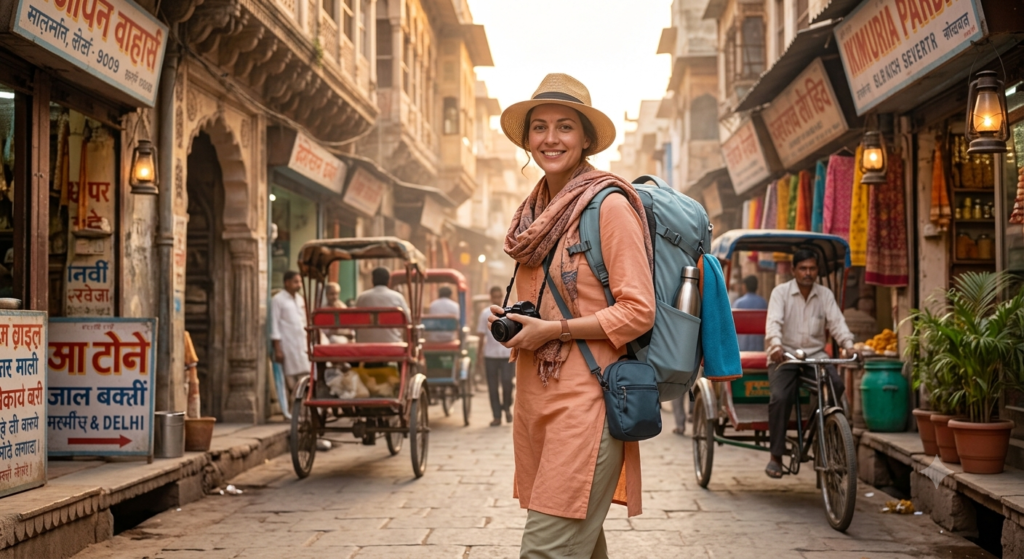
Clothing for Women:
- Loose cotton trousers, palazzo pants or long skirts
- Tops and tunics that cover the shoulders (a longer kurta is ideal and easy to buy locally)
- A large scarf or shawl you can throw over your head or shoulders at temples
- A light cardigan for cool evenings and strong air conditioning
- A modest swimsuit plus a cover-up for hotel pools and Goa or Kerala beaches
Clothing for Men:
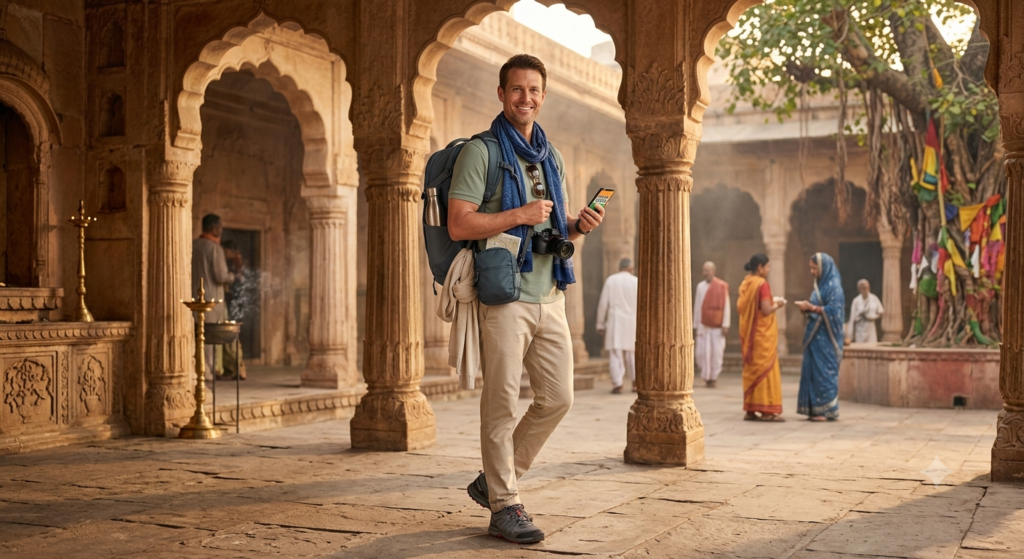
- Lightweight trousers or chinos; shorts are fine in tourist areas and beaches but not at most temples
- Breathable T-shirts and a couple of collared shirts for nicer dinners
- A light jumper or jacket for winter mornings in the north and for hill stations
- Long trousers for temple visits, where bare legs are often not allowed
Pack for the season
India has three broad seasons, and what you pack changes a lot between them. If you are not sure when to travel, see our guide to the best time to visit India.
Winter (October to March): The Main tourist season
Pleasant days and cool evenings across most of North India, including the Golden Triangle and Rajasthan. Pack light layers for the day and a warm jumper or jacket for early mornings and after dark, when Delhi and the desert can get genuinely cold in December and January. The south stays warm, so lighter clothing is fine there.
Summer (April to June): Hot and Dry
The plains get very hot, often above 40 degrees Celsius. Pack the lightest, loosest cotton you have, a wide-brimmed hat, strong sunscreen and a refillable water bottle. This is the time to head for the hills, so if you are going to the Himalayas or a hill station, add a warm layer.
Monsoon (July to September): Rain and Humidity
Warm, humid and wet in most regions. Bring a compact travel umbrella or a light rain jacket, quick-dry clothes, and sandals or shoes that cope with wet streets. Ladakh and the high Himalaya stay dry and are at their best in these months, so pack differently if that is your route.
Pack for your region:
India is huge, and a single suitcase has to work for very different places. Here is what our drivers see work best on each of the main routes.
- Golden Triangle and Rajasthan (Delhi, Agra, Jaipur, the desert): light cotton by day, a warm layer for winter evenings, closed shoes for dusty forts, and modest cover for temples. A scarf doubles as sun protection at the Taj Mahal.
- Kerala and the south (backwaters, beaches, tea hills): the lightest, most breathable clothes, insect repellent for the backwaters, a swimsuit and cover-up, and a light rain layer even outside the monsoon. Munnar and the tea hills are cooler, so pack one warm top.
- Himalayas, Ladakh and Kashmir: proper layers, a warm jacket, a hat and gloves, sturdy shoes, high-factor sunscreen and lip balm. Even in summer the mornings and nights are cold at altitude.
- Cities and nice restaurants: one smarter outfit is enough. India is relaxed about dress at dinner, but a collared shirt or a nice top is handy for upmarket hotels.
Health and medicines:
Pharmacies are common and cheap in India, but it is easier to bring your own basics, especially for the first few days. Pack:
- Any prescription medicines in their original packaging, with a copy of the prescription
- A stomach-upset kit: rehydration salts, anti-diarrhoea tablets and something for indigestion
- Painkillers, plasters, antiseptic cream and any personal items
- Insect repellent, especially for the backwaters, wildlife parks and monsoon travel
- Hand sanitiser and a small pack of tissues, as not every washroom has soap or paper
Speak to your doctor or a travel clinic before you fly about routine and recommended vaccinations and about whether malaria tablets are advised for your route and season.
Toiletries:
You can buy almost everything locally, so pack a modest kit and top up on arrival if needed. Bring travel-sized shampoo and shower gel, a toothbrush and toothpaste, deodorant, any specific skincare you rely on, sunscreen, lip balm and a razor. A quick-dry travel towel is useful for long train journeys and simpler stays, though good hotels provide towels.
Documents and money:
- Passport with at least six months of validity and two blank pages
- A printed copy of your e-Visa, plus a photo of it on your phone
- A debit or credit card, plus some cash. ATMs are widely available in cities
- Photocopies or phone photos of your passport, visa and travel insurance, kept separately
- Travel insurance details, including an emergency contact number
India is increasingly cashless in cities, but keep some rupees for tips, small shops, and rural areas. You withdraw or exchange rupees after you arrive.
Electronics and adapters in India
India runs on 230 volts, and the sockets take round-pin plugs (types C, D and M). Bring a universal travel adapter, and check that your chargers handle 230 volts, which almost all modern phone and laptop chargers do. Also pack a power bank for long sightseeing days and drives, your phone and charger, a camera if you use one, and headphones. A local SIM or eSIM with data is cheap and makes navigation and staying in touch far easier.
What NOT to pack for India:
- Too many clothes. Laundry is cheap and quick almost everywhere, so pack for about a week and wash as you go.
- Expensive jewellery and valuables you would hate to lose.
- Revealing outfits for temples and towns. Save them for the pool and the beach.
- A water purifier or heavy camping gear for a standard private tour. Bottled and filtered water is easy to find, and your hotels are sorted.
- Hard, oversized suitcases if you are doing trains or lots of stops. A softer, medium bag is easier to handle.
What our travellers most often forget while packing for India?
From driving thousands of guests, these are the things people most often wish they had packed: a scarf or shawl (endlessly useful for sun, temples and cold air conditioning), a power bank, rehydration salts for the first few days, face masks, and one warm layer for winter mornings and hill stations. Almost no one regrets packing lighter.
Frequently asked questions:
Can I buy clothes in India instead of packing everything?
Yes, and many of our guests do. Cotton kurtas, scarves and loose trousers are widely available and inexpensive, especially in the markets of Jaipur and Delhi, and you can even have clothes tailored quickly. It is a good way to pack light, stay cool, and dress in a way that suits the climate and local custom. Bring enough for your first two or three days, then pick up a few pieces once you arrive.
Do I need to bring toilet paper to India?
It is worth carrying a small pack of tissues or toilet paper and some hand sanitiser, since not every washroom provides them, especially at roadside stops and smaller sites. Good hotels and most restaurants are well equipped, so you do not need to carry much. A travel pack in your day bag is enough for the times you are out sightseeing or on the road between cities.
How much clothing should I pack for a two-week India trip?
Pack for about a week, not two. Laundry is cheap, quick and available almost everywhere, including most hotels, so there is no need to carry fourteen days of outfits. A lighter bag is much easier to handle on drives, trains and the occasional flight of stairs. Focus on breathable layers you can mix and match, and plan to wash as you go rather than over-packing.
Do I need special plug adapters for India?
Yes. India uses 230 volt power with round-pin sockets (types C, D and M), so bring a universal travel adapter. Check that your chargers are rated for 230 volts, which nearly all modern phone, tablet and laptop chargers are, so you usually do not need a voltage converter. A power bank is well worth packing for long sightseeing days and road journeys between cities.
What medicines should I bring to India?
Bring any prescription medicines in their original packaging with a copy of the prescription, plus a simple kit for the first few days: rehydration salts, anti-diarrhoea tablets, painkillers, plasters, antiseptic cream, hand sanitiser and insect repellent. Pharmacies in India are common and inexpensive if you run out. Speak to your doctor or a travel clinic before you fly about recommended vaccinations and whether malaria tablets are advised for your route and season.
What should I not pack for India?
Leave out anything you would hate to lose, such as expensive jewellery, and skip revealing outfits for temples and towns. You do not need a water purifier or camping gear for a standard private tour, since bottled and filtered water is easy to find and your hotels are arranged. Avoid over-packing clothes, since laundry is cheap and fast, and a hard oversized suitcase if your trip involves trains or frequent stops.
What are the most important things to pack for India Trip?
The essentials for any India trip are loose clothes that cover your shoulders and knees, a scarf or shawl, comfortable closed shoes plus a pair of sandals, sunscreen and a hat, a universal travel adapter and a power bank, a small first-aid and stomach-upset kit, hand sanitiser, and your passport with a copy of your e-visa. Pack those well and you can buy almost anything else cheaply after you arrive. What else you add to your India packing list depends on the season and the regions you are visiting.
Planning a trip? We arrange fully private India tours with your own car, driver and guides. Tell us your dates and we will send a tailor-made quote, usually within 24 hours. See our India tour packages or get a free quote. We hope our guide for the tips on what to pack for India is useful for you? Leave a comment if you would like to add anything to this list.
Once your bag is sorted, the trip is the easy part with a private car and driver. See how our India private tours work.


Comments (1)
Is India Safe for Female Solo Travelers? (2026 Guide)says:
August 14, 2026 at 11:34 am[…] What to Pack for India Trip: The Complete List 2026 […]